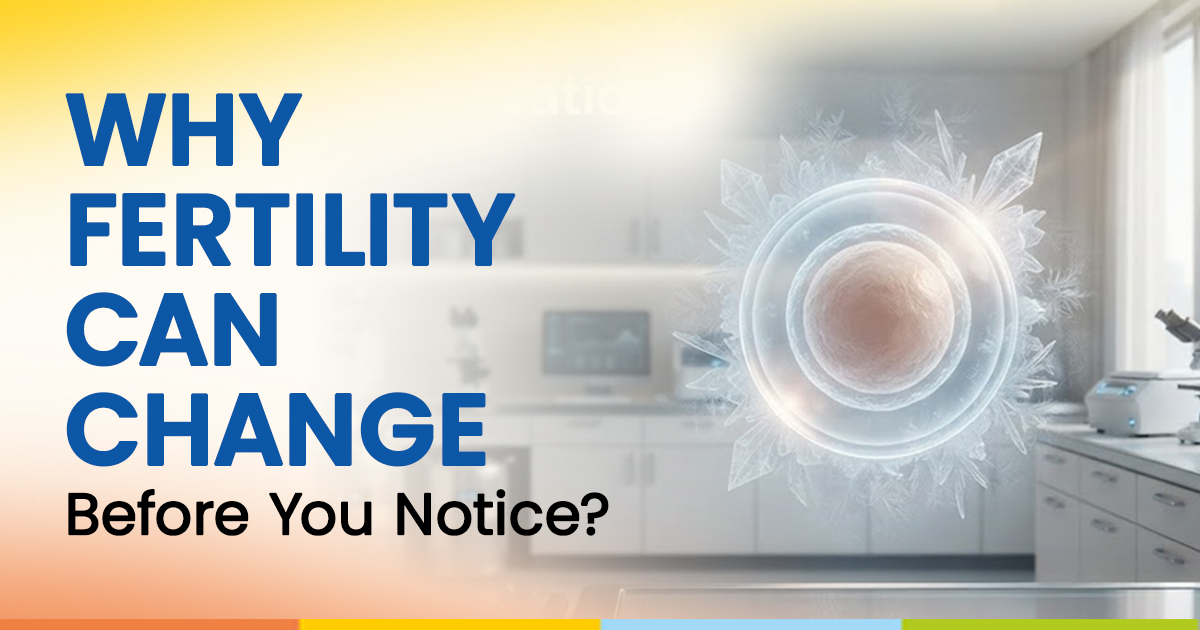
Why Fertility Can Change Before You Notice?
Fertility rarely changes overnight.
For many women, the menstrual cycle continues normally, daily life feels unchanged, and there may be no obvious sign that reproductive potential is gradually shifting. This is one reason fertility can be confusing: a woman may feel completely healthy while important changes are happening quietly in the background.
Age is one factor, but it is not the only one. Ovarian reserve, hormonal health, medical conditions, lifestyle patterns, previous surgeries, and family history can all influence fertility over time.
Understanding these factors early can help women make informed decisions rather than discovering them only when pregnancy becomes a priority.
Fertility Is More Than Having Regular Periods.
One of the biggest misconceptions is that regular periods automatically mean fertility is excellent.
A predictable menstrual cycle is certainly a positive sign, but it does not provide the complete picture.
Pregnancy depends on several factors working together, including:
- Regular ovulation
- Healthy egg quality
- Adequate ovarian reserve
- Open fallopian tubes
- A healthy uterus
- Balanced reproductive hormones
- Healthy sperm
A woman may continue having regular periods even when the number or quality of available eggs is gradually decreasing.
That is why reproductive health should not be evaluated through menstruation alone.
What Exactly Is Ovarian Reserve?
Women are born with a finite number of eggs.
Unlike sperm, which are continuously produced, the number of eggs naturally decreases throughout life. By the time puberty begins, the ovarian reserve has already reduced significantly from what was present at birth.
During every menstrual cycle, several follicles begin developing, although usually only one egg reaches maturity and is released.
Over the years, the available pool of eggs becomes smaller.
Ovarian reserve refers to the approximate number of eggs remaining in the ovaries. It does not directly measure whether pregnancy will happen, but it provides useful information about reproductive potential.
Women who are thinking about delaying pregnancy may choose to discuss ovarian reserve testing at a fertility clinic to better understand their individual situation.
Age Changes More Than Egg Numbers.
Fertility gradually declines with age, especially from the mid-30s onward.
However, the change is not only about having fewer eggs.
Egg quality also changes.
As eggs age, the likelihood of chromosomal abnormalities increases. This can make conception more difficult and may increase the chances of miscarriage or certain chromosomal conditions.
Every woman ages differently from a reproductive perspective. One woman may maintain a relatively strong ovarian reserve into her late 30s, while another may experience a decline earlier.
This unpredictability is why fertility awareness can be useful even when pregnancy is not an immediate goal.
Your Family History May Offer Important Clues.
Women often think of fertility as something determined only by their own lifestyle.
Genetics can also play an important role.
If a mother, sister, or close female relative experienced early menopause, reduced ovarian reserve, or difficulty conceiving, discussing this history with a gynecologist may be worthwhile.
A family history of early menopause can sometimes indicate that ovarian function may decline earlier than average.
It does not mean the same thing will definitely happen to you, but it can be useful information when planning your reproductive future.
Endometriosis Can Affect Fertility Quietly.
Endometriosis is a condition in which tissue similar to the lining of the uterus grows outside the uterus.
Some women experience severe pain, while others have very few symptoms.
The condition may affect fertility in several ways. Inflammation can interfere with reproductive function, ovarian endometriomas can affect ovarian tissue, and scar tissue may alter the normal relationship between the ovaries and fallopian tubes.
One challenge is that some women only discover endometriosis after they begin trying to conceive.
Severe period pain, chronic pelvic discomfort, painful intercourse, or unexplained fertility difficulties should therefore not be routinely dismissed.
Earlier evaluation may provide more options for treatment and fertility planning.
PCOS Does Not Affect Every Woman the Same Way.
Polycystic ovary syndrome, or PCOS, is frequently associated with fertility concerns.
However, having PCOS does not mean pregnancy is impossible.
The main fertility challenge in many women with PCOS is irregular or absent ovulation. If an egg is not released consistently, predicting fertile days and achieving pregnancy naturally can become more difficult.
Symptoms may include:
- Irregular periods
- Acne
- Increased facial or body hair
- Weight changes
- Difficulty losing weight
- Darkened skin in certain areas
Because PCOS varies significantly from woman to woman, management should be personalised.
Early attention to hormonal health, nutrition, physical activity, and cycle patterns may support long-term reproductive health.
Previous Surgery Can Matter.
Certain pelvic or ovarian surgeries can affect future fertility.
For example, surgery for ovarian cysts or endometriosis may sometimes reduce healthy ovarian tissue depending on the condition and extent of the procedure.
This does not mean necessary surgery should be avoided. Rather, women who may want children in the future should discuss fertility considerations before undergoing certain procedures whenever possible.
This allows the medical team to consider both immediate treatment needs and long-term reproductive goals.
Can Lifestyle Affect Fertility?
Lifestyle does not control every aspect of fertility, but it can influence reproductive health.
Smoking is particularly important because it is associated with faster loss of ovarian function and poorer reproductive outcomes.
Other factors that can affect hormonal balance and ovulation include:
- Being significantly underweight
- Obesity
- Chronic stress
- Poor sleep
- Excessive alcohol consumption
- Extreme exercise
- Nutritional deficiencies
A balanced lifestyle cannot stop biological ageing, but it can support general and reproductive health.
The goal should not be perfection. Sustainable habits are usually more useful than sudden extreme changes.
What About Fertility Testing?
Women increasingly seek fertility testing before they are actively trying for pregnancy.
Tests may include blood tests such as anti-Müllerian hormone, commonly known as AMH, along with an ultrasound assessment of the ovaries.
These tests can provide information about ovarian reserve, but they have limitations.
A high AMH level does not guarantee pregnancy, and a lower level does not mean pregnancy cannot happen naturally.
Fertility is influenced by egg quality, sperm health, the uterus, fallopian tubes, age, ovulation, and many other factors.
Testing should therefore be interpreted by a qualified medical professional rather than through online reference ranges alone.
A consultation at a fertility clinic can help women understand what their results actually mean in the context of their age and future plans.
When Does Fertility Preservation Enter the Conversation?
Some women know they want children eventually but are not ready for pregnancy now.
Others may need to delay pregnancy because of education, career goals, personal circumstances, or medical treatment.
This is where fertility preservation may become part of the discussion.
Egg freezing allows unfertilised eggs to be collected and stored for potential future use.
The procedure does not guarantee a future pregnancy, and outcomes depend strongly on factors such as the woman’s age when the eggs are frozen and the number of mature eggs stored.
Women searching for an egg freezing hospital near you should therefore look beyond simply whether the service is available.
Important considerations include:
- Experience of the fertility team
- Quality of the laboratory
- Ovarian stimulation protocols
- Egg retrieval safety
- Storage facilities
- Counselling before the procedure
- Transparent explanation of realistic success rates
Egg freezing is a medical and personal decision, not something every woman automatically needs.
Proper counselling helps determine whether it makes sense based on individual circumstances.
Fertility Preservation Is Also Medical Care.
Egg or embryo freezing is sometimes discussed only in relation to delaying motherhood.
However, fertility preservation can also be important before certain medical treatments.
Chemotherapy, radiation, or some surgeries may affect ovarian function.
When medically appropriate and when time allows, fertility preservation may be discussed before treatment begins.
This allows women to understand their options before reproductive function is potentially affected.
Being treated in a female first hospital environment can also make it easier for women to discuss reproductive concerns alongside other gynecological needs in a setting focused on women’s health.
When Should You Consider a Fertility Consultation?
You do not need to wait until fertility becomes a problem before asking questions.
A consultation may be useful if:
- You plan to delay pregnancy for several years
- Your periods are consistently irregular
- You have severe menstrual pain
- You have a family history of early menopause
- You have previously undergone ovarian surgery
- You have endometriosis
- You have concerns about PCOS
- You are preparing for treatment that may affect fertility
- You have been trying to conceive without success
For couples actively trying for pregnancy, medical advice is generally recommended after 12 months of regular unprotected intercourse when the woman is under 35, or after about six months when she is 35 or older. Earlier evaluation may be appropriate when known fertility concerns are present.
Do Not Let Online Fertility Numbers Create Panic.
Fertility discussions online can easily create unnecessary anxiety.
Statements such as “fertility ends after 35” or “a low AMH means you cannot conceive” oversimplify a complex biological process.
Age 35 is not an expiry date.
Fertility declines gradually, and reproductive potential varies between individuals.
Similarly, laboratory tests provide useful information but should never be interpreted as a complete prediction of whether someone will or will not become pregnant.
The purpose of fertility awareness is not to frighten women into making rushed decisions.
It is to provide enough information so that future choices can be made with realistic expectations.
Planning Earlier Can Create More Choices.
One of the greatest advantages of understanding fertility early is having time.
A woman who learns about her reproductive health before urgently wanting pregnancy may have more opportunities to consider different options.
Those options might involve:
- Trying for pregnancy sooner
- Treating an existing gynecological condition
- Improving hormonal health
- Monitoring ovarian reserve
- Considering fertility preservation
- Simply continuing with current plans after receiving reassurance
Visiting a fertility clinic does not automatically mean starting fertility treatment.
Sometimes the most valuable outcome of a consultation is simply clarity.
Likewise, someone searching for an egg freezing hospital near you\ may ultimately decide not to freeze eggs after understanding her circumstances. An informed decision is more valuable than automatically choosing a procedure because it is popular.
Final Thoughts
Fertility can change long before the body gives obvious warning signs.
Regular periods and good general health are reassuring, but reproductive potential is shaped by many factors, including age, egg quality, ovarian reserve, endometriosis, PCOS, family history, medical treatment, lifestyle, and previous surgery.
Understanding these factors does not mean women should live in fear of a fertility deadline.
It means reproductive health can be treated as an important part of long-term health planning.
Whether someone is considering motherhood soon, planning it years later, or simply wants to understand her reproductive health, timely guidance can provide valuable clarity.
Choosing a trusted fertility clinic, exploring an experienced egg freezing hospital near you when fertility preservation is relevant, or receiving comprehensive care through a female first hospital can help women understand their options without pressure.
The best time to learn about fertility is not necessarily when a problem appears. Sometimes, understanding it earlier simply gives you more choices for whatever you decide later.